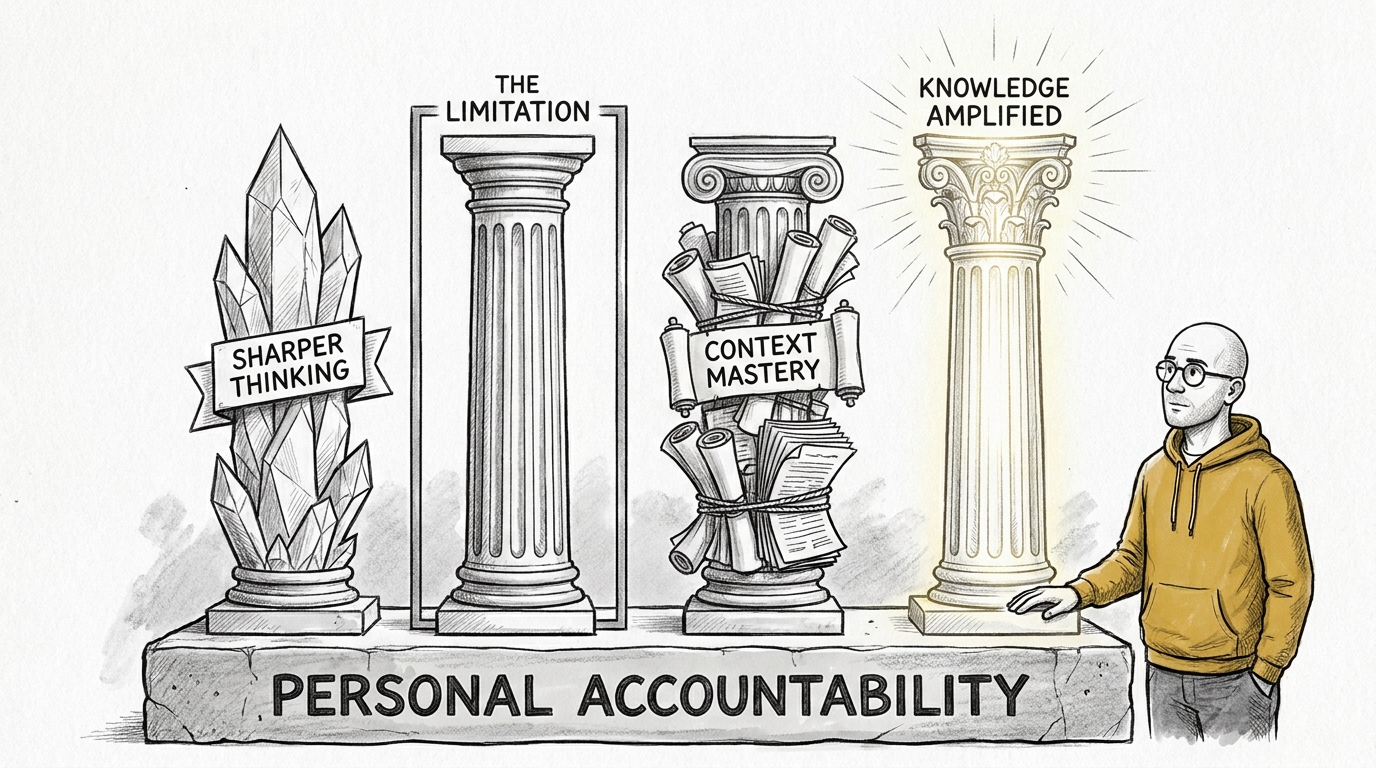
Everything Mindtastic teaches traces back to one principle: personal accountability. You own every line of code — not the AI, not the tool, not the vendor who promises their model will handle it. That asymmetry is what makes the four pillars below meaningful. Without owning the output, they are just suggestions.
Consequences of accepting personal accountability.
The common assumption is that AI reduces cognitive load. In practice, it transforms it. The boilerplate and lookups are handled; what remains is the harder work — defining what should be built, validating that it was built correctly, and holding the full system model in mind.
The bottleneck is no longer typing — it is the quality of thought behind the prompt. That is good news for experienced developers and a significant challenge for those who were using the act of writing code as a substitute for understanding it.
An LLM processes what is in the context window — nothing more. It cannot surface what you did not know to include, cannot question your framing, cannot notice the constraint you never mentioned.
The rounding error that charges customers three cents too much on every invoice, every month, for three years: no model finds it unless you know it exists. Understanding this limitation is what makes context architecture (pillar 3) necessary and domain knowledge (pillar 4) decisive.
Everyone talks about prompt engineering. Fewer talk about context architecture — what you actually load into the context window before writing the prompt. The quality of AI output is proportional to the quality of context input.
A developer who understands the business domain, the system architecture, and the constraints will get dramatically better results than one who just describes what they want. Context mastery is not a prompt trick. It is the result of knowing your domain deeply.
Senior + AI = extraordinary results. Junior + AI = faster mistakes. This is not a prediction — it is an observation from repeated implementations across organisations. AI amplifies what you bring to it. Domain knowledge, architectural judgment, production intuition, pattern recognition from years of debugging: all of it becomes more valuable when AI handles the mechanical work.
The gap between experienced and inexperienced developers widens with AI. The correct response is not to pretend otherwise — it is to invest in the training that builds the foundation capable of using AI well.
Tomas André
Developer, architect, trainer. Three decades of shipping production code — not presentations. Mindtastic exists because AI training should come from someone who builds with it every day, not someone who read about it last quarter.
More about Tomas André →We'll tell you what will work and what won't — before you commit to anything.
Get in touch